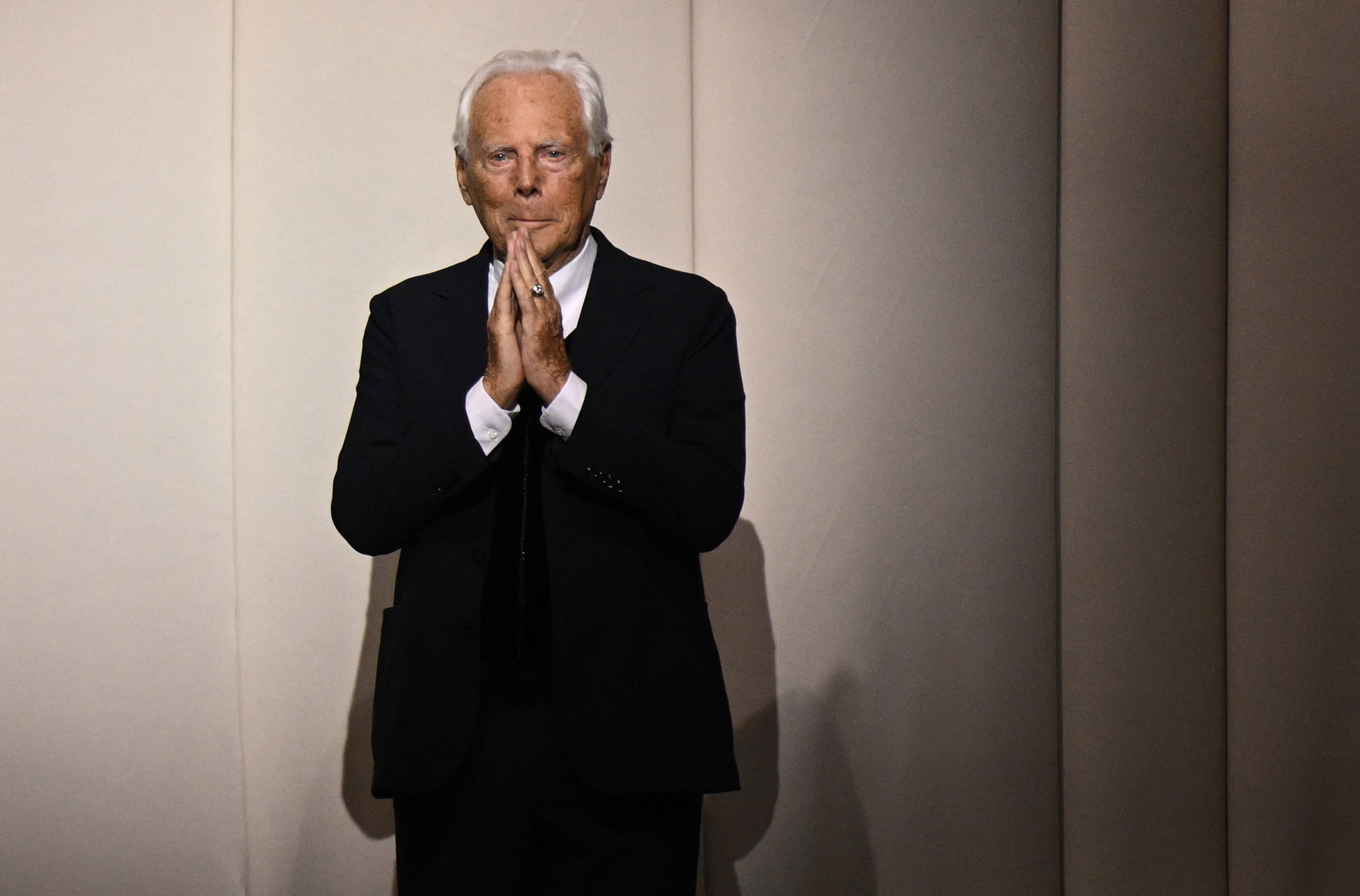
Rest in Peace: Giorgio Armani, 91, Passed Away
Thursday, Sept. 4 – Italian fashion designer Giorgio Armani passed away on Thursday. He was 91.
Giorgio Armani: Career Highlights
Birth and Early Life (1934–1950s)
Italian fashion designer Giorgio Armani was born on July 11, 1934, in Piacenza, northern Italy. He was the second of the three children. Before entering the fashion industry, he briefly studied medicine at the University of Milan, but after serving in the military, he left academia to pursue a career in retail. He began his career as a window dresser at La Rinascente, a prestigious Milanese department store. He later transitioned to a buyer role, developing a profound understanding of fabrics and customer preferences. These experiences shaped his sharp eye for design and aesthetics that would later define his career.
Transition Into Fashion (1960s–Early 1970s)
In the early 1960s, Armani was hired by Italian designer Nino Cerruti to work at Cerruti 1881, where he was responsible for designing menswear. His work under Cerruti refined his tailoring skills and introduced his signature style of soft, unstructured suits, which broke from the stiff, formal cuts of traditional menswear. By the early 1970s, Armani left Cerruti and began freelancing, collaborating with other Italian fashion houses while preparing to launch his own brand.
Founding of Giorgio Armani S.p.A. (1975)
On July 24, 1975, Armani and his business partner Sergio Galeotti officially founded Giorgio Armani S.p.A. in Milan. The company released its first men’s collection that same year, followed quickly by women’s wear. Armani’s sleek, minimalist aesthetic attracted instant attention, setting a new standard for elegance in the ready-to-wear fashion industry. His early collections captured the momentum of Italy’s growing fashion industry, quickly positioning Armani as a rising star on the international stage.
Breakthrough and Hollywood Fame (1980s)
Armani’s global breakthrough came in 1980 when actor Richard Gere wore his designs in the hit film American Gigolo. The movie showcased Armani’s unstructured jackets and fluid tailoring to audiences worldwide, cementing his reputation as a modernist innovator. By 1983, Armani had opened an office in Los Angeles to work directly with Hollywood clients, strengthening the link between fashion and cinema. During this decade, his brand also diversified into Emporio Armani, Armani Jeans, and Armani Junior, making his name accessible to a broader audience.
Brand Control and New Ventures (1990s–2000s)
Unlike many designers who sold stakes to luxury conglomerates, Armani remained fiercely independent. He began reducing reliance on external licensing and brought production in-house, ensuring quality control. During the 2000s, Armani expanded into new industries, launching Armani/Casa for interior design, Armani/Fiori for floral services, and Armani/Dolci for gourmet chocolate. In 2010, he further extended the brand into hospitality by opening the Armani Hotel in Dubai, followed by another in Milan.
Legacy Planning and Foundation (2010s)
In 2016, Armani established the Giorgio Armani Foundation to ensure the company’s long-term stability and independence. The foundation not only safeguarded his empire from acquisition by conglomerates but also funded social projects. This move reflected Armani’s meticulous planning for his brand’s continuity and his philanthropic outlook. By this time, his company had become one of the most successful independent fashion houses in the world, with billions in annual revenue.
Final Years and Passing (2020s)
Even in his late years, Armani remained actively involved in design. In 2023, his Venice runway show earned a standing ovation and was seen as a poignant farewell to his era. Known for his perfectionism, Armani was still reviewing designs and ensuring every detail reflected his minimalist vision until the very end. On Sept. 4, Armani passed away at the age of 91, leaving behind a multibillion-dollar global fashion empire and a legacy that revolutionized the way the world dresses.